Monday, 26 November 2012

The North - getting there

The Northern Adventure begins - the journey there

Pea Soup
We set off for our northern adventure on one of those foggy London days that people call ‘pea soup’, and that Sherlock Holmes describes loosing his criminals in. We trudged through the mist to pick up our car, which to Tony’s delight had been upgraded from a VW Polo to a Pergeot 308CC convertible - not that the weather was going to be conducive to having the top down.  

Our first stop was Kings College Chapel in Cambridge - partly because it was on the way to Yorkshire where we were spending the night. We walked through the beautiful streets of the university town to get to the Chapel. It was graduation day so we had the added bonus of seeing the students striding around in their gowns, posing with their parents. 

Busy Cambridge Streets
Inside the Chapel was as beautiful as I remembered from my visit with Mum and Dad in 1998. What I hadn’t remembered was the intensity of the Tudor motifs. As one of the plaques pointed out, the Tudors had just won a long civil war, and so probably felt entitled to revel in creating a beautiful church filled with their red and white rose. While we were sitting and enjoying the stained glass windows and the elegant fan vaulted ceiling, the Organist started practising. We finished out visit bathed in the peals of the organ as it echoed around the walls. 

Outside Kings College Chapel
We bundled ourselves back into the car - and because it now gets dark (proper dark) here at about 4pm in the afternoon, abandoned plans to drive through Ely (it apparently got its name from the Eels that use to thrive in the water around the village - eel pie is still served as a local speciality) and headed straight for Yorkshire. 

We were booked into The Mount House, a stunning B&B in the little village of Terrington which is in estate of Castle Howard. The drive was tough - only 2.5 hours - but all of it in the pouring rain on unknown roads. We arrived tired at 6.30 to be welcomed into the lovely warm house of Kathryn and Nick and their two Labradors and a cat. After a glass of wine, the tail end of the rugby, good chats to our hosts and a freshen up, we jumped back in the car to head to the local gastro pub ‘the Durham Ox’. Named after an Ox that was apparently over 1000k and stood 5’10”, the pub is in the village of Crayke which sits at the bottom of the hill that the Grand Old Duke of York marched his 10,000 men up and down.  The pub served excellent local steak, game, and deconstructed apple crumble. perfect fare in the cold and wet. 

We drove through the winding country roads back to the Mount House and curled up in our gloriously soft bed. 

Houses, Romans and Ruins 

After a lovely leisurely breakfast, with plenty of coffee, pats of the dogs, and lessons on my ipad for Kathryn and Nick, we packed the car and set off. We had wanted to go for a walk locally but persistent rain and strong wind meant that it would have been just miserable. Instead we went for a drive around the nearby villages while we waited for Castle Howard to open.

Castle ruins at Sheriff Hutton
One of the most amazing things about driving through Britain is the ability to drive through a village, and look up and see the ruins of a castle or an abbey. Our first real experience of this was driving through the village of Sheriff Hutton. We pulled off the road to take photos. What was most striking was that the village had probably been there as long as the castle had, and when the castle fell into ruins, the village just continued on around it. 


The approach to Castle Howard
Getting excited about castles was nothing compared to Castle Howard. We were very lucky as many of the manor houses are only open during the summer - however Castle Howard opens again for the end of November  (yesterday to be exact) until Christmas so the public can see the house decorated with lights and holly. Castle Howard was the set for Brideshead Revisited, and for anyone who has seen the movie, you may remember the approach to the house - long straight roads through archways and gatehouses lined by trees. Even in the winter with the trees all bare, it really is breathtaking. 
Walls - to keep things out - or in
The door to the walled garden

We got ourselves tickets from the stable courtyard where the visitors’ reception is and wandered down the hill towards the house. On the right hand side of the walk down is the walled rose garden and ornamental vegetable garden. We opened a very unassuming door in the wall and suddenly found ourselves in a private world. It felt just like something from The Secret Garden (Tony hasn’t ever read or seen it so I had to give him the Reader’s Digest version as we wandered around). No one else visiting the house was bothering to look at the grounds (it was still raining and quite cold) so we had the place entirely to ourselves. 


The front of Castle Howard

The Moat
The house itself is so ‘happily situated’ by the shores of a large lake, surrounded by woods and rolling hills. Built around 300 years ago by the Howard family - after their brush with royalty when HenryVIII married Catherine Howard and then beheaded her - and has been owned by the same family ever since. The tour of the house is really comprehensive - walking through bedrooms, music rooms, through the main entrance hall (with a quick stop to warm up by the fire), up the stairs to look down from the gallery. Adorned with christmas decorations it actually felt like a home. Pictures of the current generation of children stood on the desks and pianos as they would in any house, and presents under the various christmas trees were wrapped and named by a mother (and not a stylist). Unlike visiting Versailles - which just feels like a museum - Castle Howard was a modern example of how to run a large (and expensive) house, whilst remaining engaged with the local community that now supports it - rather than the other way around. 

Castle Helmsley
From Castle Howard we headed for the Yorkshire Moors for a taste of Wuthering Heights. At the entrance to the Moors National Park however we got sidetracked by the castle in the village of Helmsley. The castle had been started in the 1100s and added to over the next 600 years. It has quite amazing defenses which still survive - a ditch, a very high hill, then a deep moat, then another steep hill and then the castle. During the English Civil War the defenses were tested as the castle was under siege for 3 months until they surrendered. The parliamentarians  determined that the castle be destroyed to prevent it being used in future by the royalists - and so most of the towers were knocked down - and later pillaged by local farmers for the stone. We had a great time clambering around the ruins in the cold and imagining how hard it would have been to actually attack such a well placed castle. 

From Helmsley we drove into the moors. The countryside actually changed colour - from rolling greens to reds and browns - and craggy peaks. It was easy to imagine it as a fitting scene for King Lear to be wandering and Heathcliff to be ranging. A couple of quick roadside stops for photos and we headed for Hadrian’s wall and the remains of Corbridge Roman Town. 

The Moors
The Grain Stores at Corbridge Roman Town
We got there just on dusk (3.30pm) and rushed out to wander the streets of what was once the frontier of the Roman Empire. We were quite astonished at the level of sophistication in the frontier town - carefully constructed grain silos with channeled air underneath the floor to keep the grain dry, stone drains in the streets (with carefully laid stones to allow you to cross without falling in). But most amazing of all was the road - the main street - which connected Corbridge with the other Roman Towns along Hadrian’s Wall all the way across. By the time we finished it was too dark to see the wall itself so we set the TomTom for Edinburgh, and we’ll catch the wall on the way back South. 

As I write this we have just crossed the Boarder into Scotland and will be in Edinburgh in an hour. The real North begins. 

Wednesday, 17 October 2012

Candlelit '20s

A night out by candlelight

Since moving to London I have been itching to engage with the history of the place - so much as passed within these walls, and on these streets, and I was sure that somewhere in London I could find a bit that felt like the past.

You have moments, walking through the old cobblestone streets that survive in London, under the eaves of Tudor buildings (Tony always tells me they're fake), when you feel like you're transported to another time. They're rare as you travel your way to work on the tube in your corporate suit but they are there.

They are also there when you look for them. I went hunting for a 1920s night - and I found it. The Candlelight Club is a 'secret club' (with a facebook site and a webpage). Every month they organise and run a 1920s night with well researched cocktails, a band playing hits from the 20s, champagne in flat glasses, and a slightly different take on the 20s each time. During the Olympics it was 'games in the 20s', before that 'rum runners', and the weekend we got tickets for - 'an Indian Summer'.

Tony decided that if I was going to drag him along to this pretend night in the 20s, that he would at least embrace it full on. He shaved his beard off - much to my horror, found the suite in his wardrobe that suited the indian theme the best, and got into the drinking champagne out of flat glasses thing with gusto.

I decided I wouldn't wear the flapper dress I made last year - as every other girl would be in one. I instead chose to be a little ahead of the times with a 1930s dress in silk, floor length, with batwings, covered in a frangipani pattern, to better complement the Indian nights.

The nights are impeccably organised - secret locations communicated the night before, excellently researched cocktails, nibbles, and band. We spent half the night drinking and eating and watching everyone else, and the rest of the night carving up the dance floor - not sure dancing salsa to 20s is quite the done thing but oh well.


The room is entirely lit by candlelight - and I had never realised quite how bright the rooms must have been before lightbulbs. I did go home covered in candlewax - and looked up how to remove it the next morning - but it gave the whole night a special feel.

We are booked to go to the next one with a group of friends - Halloween Ball 20s style - suggestions for costumes welcome. Can't wait.


Thursday, 11 October 2012

The Globe - lessons in English History via Shakespeare

Richard III and Henry V at the Globe


I remember in high school when one of my English teachers said that London had recreated Shakespeare's Globe. I don't remember if I was skeptical about a 'fake' globe and whether it would feel all a bit too much like pretending to do things 'how Shakespeare intended'. Tony certainly was when I announced to him that we would be going along to not one, but two Shakespeare plays at the Globe before the summer was over.


An empty Globe
It turns out that whilst the Globe is open for tours all year round, it only has a theatre season during the summer. Having now been to see a play outside at the end of September in London I can see why. The Globe's only modern convenience inside the theatre itself are lights - just enough to allow them to do evening performances until daylight savings ends - not stage lights, no spotlights and no special effects. There is no roof, you are exposed to the wind, the rain - and even the passing aircraft . It is glorious but requires a certain amount of luck, and warm clothing.


Once you walk through the doors, push past people,  find your seats (if you're amongst the posh crowd), or get a good vantage point from the floor, you are transported back 400 years. The theatre with its wooden posts supporting the upper seating levels, the bare benches (cushions are £1 each to hire on the way in), the marbled pillars and painted backdrops are excellently done. It is a remarkably small space (whilst seating and standing hundreds), which allows for the actors voices to travel to the highest reaches (even over a buzzing helicopter).

Handsome Henry V
We went first to see Henry V - my favourite history Shakespeare - at the end of August. It was still hot - and we went without jackets. We had splashed out on the posh seats (at about £35 each plus cushions) and were sitting on the lower level - about level with the stage. When we bought the tickets they warned that the view was obstructed (this is really common as the supporting posts go all the way around and are really solid - probably a good thing). I sat behind the pillar as I know the play well and wanted Tony to see everything that was going on. I did spend much of the play chasing the actors around the stage by leaning this way and that to see around the pole - but it didn't matter. As soon as the Hearing the opening lines of the Chorus implore you to forget your hard seats and the confines of the 'wooden O', you really are transported to the fields of France imagining the thousands of soldiers, the horses, the castle walls and the shouts of battle.

Somehow I don't think i'll ever quite be able to enjoy the way Shakespeare is done in modern times in quite the same way. Growing up on Bell Shakespeare I always enjoyed the modern twist he'd add, modern dress, amazing sets, music etc. The 'real deal' at the Globe however highlights how perfect these plays are as they were written - timeless in both their story-line, and their audience appeal - without the need for costume, music or set to translate for a modern audience. In particular the jokes and audience throws were so much more obvious - the way in which Shakespeare plays to the crowd and engages them in the action. Tony spent the whole time wanting to cry out 'he's behind you'!

In Henry V the crowd was the army King Henry appeals to through his St Crispian's Day speech. We were the soldiers expected to rush forth in full battle cry in response to 'once more into the breach dear friends, once more!'. I have never before felt such an urge to rush onto the stage and be part of the action.

Pistol and the Welshman - eating the leek
In Richard III, in once scene where the guards were debating whether or not it was right to kill the Duke of Clarence as ordered by Richard of Gloucester. Mid debate one knelt and asked the closest member of the audience 'what do you think?' At once the audience thought 'I'm glad he didn't ask me' while also laughing at the engagement with the audience on this moral dilemma.

Roger Lloyd Peck as Buckingham
We unknowingly booked tickets to the closing night of Henry V - which meant that the actors were in full flight. The Welsh jokes were flowing in particular - more text populated with 'Look You's' than I remembered from Shakespeare's text - but the actors were evidently enjoying themselves.

We were also really impressed with the quality of the actors. Roger Lloyd Peck (who I knew first as the eccentric father from Cold Comfort Farm) played an outstanding Buckingham. I recognized 'Sir Pitt' from the BBC's Vanity Fair - playing Pistol. The other actors - whilst I didn't recognize them - were superb.
Richard III and Anne (a male actor playing a woman)
Richard III was Tony's favourite. Captivating from the first moment we walked through the doors - finding our standing 'seats' part way through the introduction with a drink in each hand - we were immediately held by Richard. Not a hunchback - but a deformed cripple as Shakespeare implied, we was excellent. The audience loved and hated him at the same time. Once he was asked (by his own design) to be king, the audience was invited to cry 'God Save King Richard, the one and rightful king' - which we did dutifully.

We exited both performances absolutely brimming with excitement and praise at what we had just witnessed - and next season we will make it to every show. 

Saturday, 25 August 2012

I want to go to Brighton!

I Want to go to Brighton!

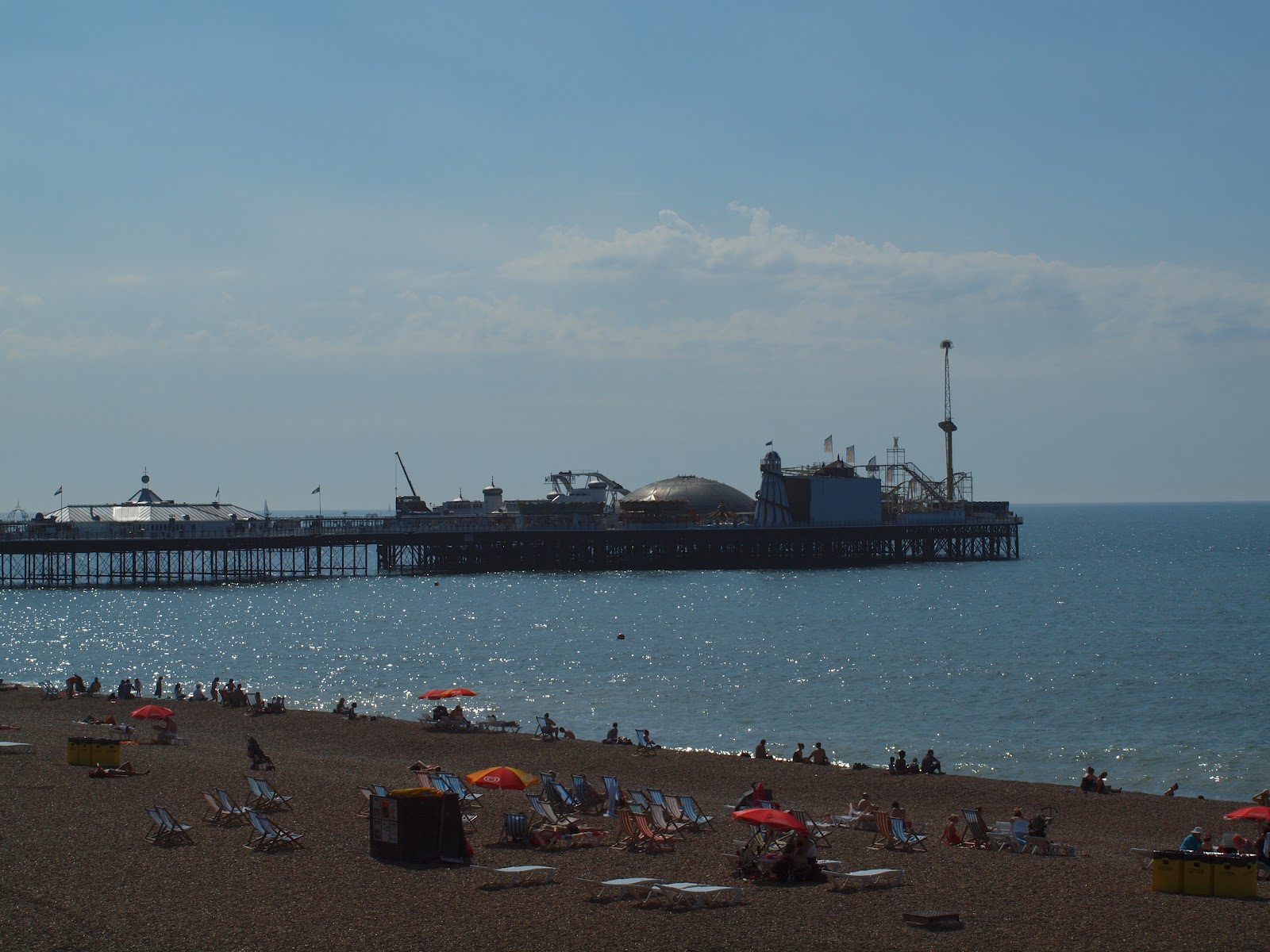
Brighton Beach

On about Tuesday last week Tony and I decided we wanted to go away for the weekend. We looked on the map, and after looking at some lovely escapes recommended by Sawdays over near Bristol, we decided we just wanted somewhere close. As it turned out - one of the  closest pieces of beach to London is Brighton. 

All I knew of Brighton was that it was the scene of Lydia's disgrace in Pride and Prejudice - and that 'a little sea bathing' would have set Mrs Bennett up forever.  Nevertheless we threw out 'togs' and beach towels into our duffel bags, slung them over our shoulders and jumped on the train with all the rest of London escaping to the beach for what was forecast to be a properly sunny weekend.

Brighton Pier
Brighton, no longer the place of Regency era parties, balls and promenades, is now a bustling English resort.  We booked into The Old Ship Hotel facing the waterfront and neatly between Brighton Pier and West Pier, in a room on the top floor overlooking the sea. The hotel was once obviously the scene of dances, with reception rooms still used today for weddings and the like. It had lovely folding doors opening the bar and restaurant onto the beachfront - letting in the sea breeze where we ensconced ourselves with cold beer to escape the heat.

We had spent our morning wandering the promenade, taking in the carnival sights on Brighton Pier (which is basically like sideshow alley from the Canberra Show - but over the water).Do not be fooled into thinking that any actual fishing or boats are associated with this Pier. I imagine if you were a teenager spending the summer in Brighton with your folks, it would be a great place to kill time - but for us we were more than satisfied with a quick walk the full length and back - cultural experience done.

Below the Promenade

One thing that has amazed us is the lengths the English went to to transform the beachfront for their purposes. Apart from the two huge piers - but built for leisure not work - a promenade the entire length of the heads was built - with wrought iron arches, and long gentle ramps to take you down to the sea.  Such effort to fore the sea to shape to people seems very at odds to us as Australians - even Bondi hasn't tamed the beachfront to this level. The promenades do however provide a useful roof for bars, clubs, restaurants and cafes that line up to serve the swarms of people promenading their way past.
Pebbles for Sand

Tony being forced to pose for a photo
Also very odd to us was the pebbly beach - quite painful to walk on rare foot - but conveniently means you come out without the usual covering of sand. We only bothered to go in up to our knees but spent a long time sitting on the pebbles watching other people play in the tame surf less water. With no waves, and therefore no rips, we realised why it is that English tourists get to Bondi and promptly have to be rescued by our lifeguards. They haven't grown up with an understanding and respect for the rules of the waves and the sea.

The only way to sit on this beach
After buying me a large sun hat (I left all mine in Australia) we also realised how little respect there is here for the sun. We re both covered in 50+ sunscreen, and me now also in my umbrella sized hat and still felt it was time to heat out of the sun after a few hours. However no one else seemed to ca re - most of them were lobster coloured with sunburn, and no one had a hat on - not even the children. Whilst no where near as ferocious as the Australian sun, the English sun on a summer day is certainly enough to make you burn.

Lunch time found us looking for a traditional fish and chips - of which here were lots - serving fresh fish heavily battered with great chips in cones of paper - vinegar not lemon. We took ours to the edge of the promenade to watch the beach whilst eating. Within a few bites however we were ducking for cover as the seagulls appeared from nowhere, stealing pieces of fish in their beaks and knocking into our shoulders ant almost taking my hat in their rush to get our food. We sought shelter in a nearby bus stop until they dispersed - much to he amusement of everyone walking past.

The oldest surviving
Victorian Bandstand - apparently
The pleasure gardens
After our scene from The Birds was over we hid from the sun in The Lanes - the oldest parts of the town which were one the old fishing village before sea bathing became a fad and brought the whole of London to visit every summer. I had hoped the Lanes might be full of vintage - and everyone had told me how wonderful they were.  Unfortunate they were all new shops - just in lovely narrow and old lane ways. I think I've been spoiled by Portobello rd - but I can't be bothered with chain stores regardless of how quaint their surroundings.


West Pier
Probably my favourite part was the ruins of the West Pier. About 200m down the beach from the carnival of the Brighton Pier, stands an iron shell of a very large pier. It was built in 1880s and a ballroom and concert hall was added in the early 1900s. It must have been an amazing venue - right out over the water- with grand Victorian architecture and music floating out into the night over the sea. The pier sadly closed in 1975 when the corporation that owned it went bankrupt. It slowly fell into disrepair, although you could go on guided tours of it until large storms damaged it during the 90s, and the walkway was removed for safety reasons. In 2002 it suffered 2 huge fires that completely gutted the structure.  Fire crews couldn't put the blaze out ash they had no way of reaching it.  There has been talk of restoring it to its former glory however the cost would seem prohibitive. Until someone finds the money it is now only a blackened reminder of a more elegant past for a city that has hopes of somehow finding its way back there one day. 


Saturday, 11 August 2012

Paris in the summer

Paris in the summer

The wonders of airbnb

Passage Verdeau
The passage behind the passage
We have discovered airbnb - how people travelled Europe on a budget without it is beyond me. Through the wonders of this site we found Delphine and her lovely flat, hidden away in the passages of Montmartre. In the 19th century the Parisians built a network of beautiful glass ceiling'd passages for shoppers - to keep them dry and off the busy, dirty muddy streets. Behind these passages, apartments were built - only accessible through the passages, with no direct street frontage. The passages are locked at night, so only residents with the code or key can access these gems and wander in the semi dark to their private retreats in the centre of Paris.

Delphine's flat was in behind Passage Verdeau, one of the smaller passages in the network, through a locked door, down another passage, up 3 flights of stairs. Not recommended for those who have heavy luggage or can't manage stairs - but for us sprightly young things, it was a secluded wonder, with full length windows opening to give us a view over the tops of the passages and a glimpse of a hidden part of Paris missed by most tourists.

I had been a little nervous about renting a flat from a website (those who know about our disastrous experience upon arrival in the UK will understand why), particularly in a country where I didn't speak the language very well, and hadn't ever been as an adult. As a result I had chosen to rent a flat that we would have all to ourselves. Airbnb offers entire flats, rooms in houses, shared rooms - you name it - however sharing a flat with a stranger was not what we had in mind for our four day romantic escape. However I shouldn't have been worried - I had messaged with Delphine our host several times before our arrival, and she seemed lovely. Upon arrival (she even came out to find us in the rain when we couldn't find the passage), she gave us a tour of the flat, provided cake and tea, and had even given us a list of the local cafes and restaurants that she liked to frequent, and an outline of her favourite walk through the passages with turn by turn instructions.

The flat was a wonderful base for our 4 day adventure - we were hardly there as we tried to pack in as much of Paris as possible - however when we came home exhausted at the end of each day it was wonderful to feel you were in the real Paris, in a Parisian's flat (beautifully and tastefully decorated) and not in a hotel for tourists. 

Versailles

The front gates of Versailles - and the line...
Our first day in Paris however was spent as real tourists, wandering around the gilt halls of the Sun King's Palace - Versailles. When mum and dad brought us here in 1998 I remember much of the palace was under restoration - however it was early Spring and I have no recollection of crowds. Visiting again 14 years later and in the height of the summer tourist season was quite a different experience. Much of the restoration is completed, and the palace has built special entrance halls to deal with the huge numbers of tourists that trek out of Paris central to wander the ornate halls.

Lines of old Kings
Once we were through the line to get in - which wound itself around much of the front courtyard of the Palace like a long impatient snake - we joined another long line of people walking dutifully past an exhibition of the history of Versailles. Here I pause to have a quick tourist rant. Why do people take photographs of paintings? and even more irksome - why would you video a video, or indeed video the entirety of your visit to a place - capturing every window, painting, statue you walked past. When do you think you will sit and watch the entire tour of Versailles captured on poor quality hand shaky video? Or worse - which poor relative are you going to force to watch it? I guarantee the internet will have a copy of every painting in there, and even a virtual tour if you so desire. Stop watching your screen - and actually be in the moment.

Rant aside - taking photographs is in itself enjoyable - capturing just the right angle, composing an interesting image that leads the eye through the frame, or working with tricky lighting to capture rich colours and texture. I captured some photos of the parts I enjoyed the most. Long corridors lined with statues of past kings, courtiers, scholars, rich tapestry and furnishings.
The King's public bedchamber

The bedchambers of the King and Queen were closed when I was last at Versailles - however they have now been loving restored to their original overpoweringly opulent state. Can you imagine sleeping in a room this busy - not just busy with colour, gilt and pattern, but also with people? The King's bedchamber was a public court space where the King held audience - and in the evenings, the court gathered to put the monarch to bed and tuck him in.

The sights of Paris by Velib and boat

I think I can confidently say we discovered every possible thing that could go wrong with using the public bicycle system in Paris (lovingly named 'Velib' - part 'velo' part 'liberte') - except for falling off or getting run over. After working out how to use the machine to get ourselves day passes, then working out how to actually release the bicycles from their stands, the first two I got were broken - one suffering from a broken chain guard that got caught in the wheels, the other from a missing pedal. Once we found two that had all of their parts in working order we took off rather hesitantly down the street. 

Tony on Velib with phone
It was a fantastic way to see the city. Rather than travelling by metro and missing all the interesting details in between, you rode past them, could stop, take photos, and if you were especially keen, put the bicycles in a stand, go in, enjoy, come out, get new bicycles and be on your way. They cost next to nothing - $1.30 for the day pass plus about $1 per 30 minutes after the first 30 minutes (which was free).  Best of all - unlike driving a car around, if the traffic got a bit much or there was a scary intersection, we simply got off and walked the bikes across the pedestrian crossing or down the footpath. 

Annie at the Arc
We rode all the way from our apartment in Montmatre, past Opera, Madeline, down to the Obelisk, up the Champs Elysees to the Arc de Triumph. We happened to choose Bastille Day for our cycling adventure - so we encountered many roads closed for the military marches and lots of crowds  - but it did mean that the Arc was looking amazing with a giant French flag hanging in its centre.  We tried to go up - however it was going to cost 10 Euro each, and there was a long line so we gave it up in favour of cycling on in the general direction of the Eiffel Tower. After gazing up at the Tower we cycled merrily homewards, along the river and up winding side streets tired but successful. 

We were so pleased with ourselves and conquering the Velib that we decided we would ride up to the Sacre Coeur to get dinner and watch the fireworks.  We discovered that from our apartment to the Sacre Coeur is one big hill - and the 3 speed Velib weren't ideal for the task. We did make it - huffing and puffing to the steps of the magnificent church - only to discover there was no where to put the bicycles away. After a long 'discussion' we finally rode much of the distance back down the hill, returned the bikes, and walked all the way back up. Lesson learnt - work out where the nearest velib station is before setting out.

The next day we decided to take the ultimate tourist tour - the boat trip down the Seine. For next to no money we had a sunset cruise past all of the main sights. Our favourite comment by our tour guide was as we passed the Obelisk - it was described as Paris's oldest monument. We wanted to point out that the only reason it was old was that it had been somewhere else for thousands of years - and Napoleon had stolen it only a matter of a couple of hundred years ago.

The river afforded a pretty amazing view of many of the beautiful buildings in Paris - but my favourite were the Grand Palace and the Petit Palace - the French exhibition buildings build around the same time as the Eiffel Tower. At sunset the true magnificence of their glass and steel structure was outlined against the sky.

The Exhibition Palaces. 

The things people do for religion 

Our tour of Paris had turned into a bit of a 'tour of things from the outside' - the lines for everything were huge and we had left it too late in the day on our second last day to get inside Notre Dame. We did enjoy the outside however and the grand flying buttresses. Tony's favourite was the statute of the first bishop of the church that stood on the site of Notre Dame - he was martyred by the romans who cut off his head. So when Notre Dame was built, they portrayed this bishop along with all the others by the front doors - holding his severed head in his hands...
Holding his head in his hands
The absolute highlight of the trip was on the last morning - we finally waited in line long enough to see the inside of the Saint Chapelle cathedral. On the Ille de la Cite - at the other end from Notre Dame is a much smaller - but more glorious - church. Built to house the 'Passion Relics' - bones and other relics of Jesus including his crown of thorns apparently, the Capetian King Louis IX spent more buying the relics than on building the church. As you can see from the pictures below - the relics must have cost a fortune because no expense was spared on the church.
The lower chapel - for the commoners

Much of the church was under much needed restoration, however it didn't detract from the overwhelming beauty of this church. Walking into the lower level chapel first, the simplicity of the gothic lines, the bold red and blue paint work with the pattern picked out in gold was stunning. The commoners who were permitted to worship here must have felt the presence of God - with the blue and gold ceilings dotted with painted stars and the gravity defying arches.
The upper chapel - for the king and the relics

Up a narrow stone staircase (the King used to enter from a link to the next-door palace that no longer exists), you come out into the main chapel. The light and colour really does take your breath away. Each of the windows tells the story of one of the books of the bible - with the story of Jesus and the resurrection in the middle over the alter - and somewhat obstructed by it. You read them like a book - moving from one image to the next from top to bottom - a simple and  beautiful solution to a population who couldn't read.

We retired to our apartment to pick up our bags, buy some cheese from the local fromagerie and jump back on the Eurostar to London. 

Wednesday, 25 July 2012

An Antarctic adventure in London - courtesy of the Natural History Museum

The Natural History Museum

The Museum

The NHM - true temple of nature
Tony stands patiently outside
Tony and I realised early on in our London life that if we weren't careful, we'd leave here to go home to Australia in a few years having seen lots of things outside of London - and nothing in it. Weekends were quickly being swallowed by domestic stuff and lazy breakfasts on our rooftop. So, after yet another Saturday morning cleaning and shopping, we dragged ourselves out of the house on a sunny Saturday morning and set out to start ticking off some London tourist destinations. We had already achieved the Tower of London when Kate and Cam were here, and St Paul's when our dear friend Liz came to visit recently (I feel we will accomplish quite a few courtesy of having guests) - but none on our own. 

We had heard that the Natural History Museum was showing an exhibition on Scott's expedition to the South Pole which we were keen to see - and the museum's permanent collection is free - so we thought it was worthwhile heading over for even just a few hours. 

Dog flanked by fish
Dog flanked by lizards
Pelican/pterodactyl - flanked by leaves
The NHM - built in the height of the Victorian era's fascination with science, is a 'true temple of nature' - designed from the ground up with flora and fauna in mind. Like gargoyles on a church, the pillars and drains of the NHM are decorated with beautifully carved animals - both as the prominent features, and as the flanking decoration. My favourites from the outside are below - Tony stood very patiently while I took lots of photos. In particular I love the dogs flanked by lizards and fish - and the one below where I can't work out if it is a modern day pelican or a relic of the dinosaur age.

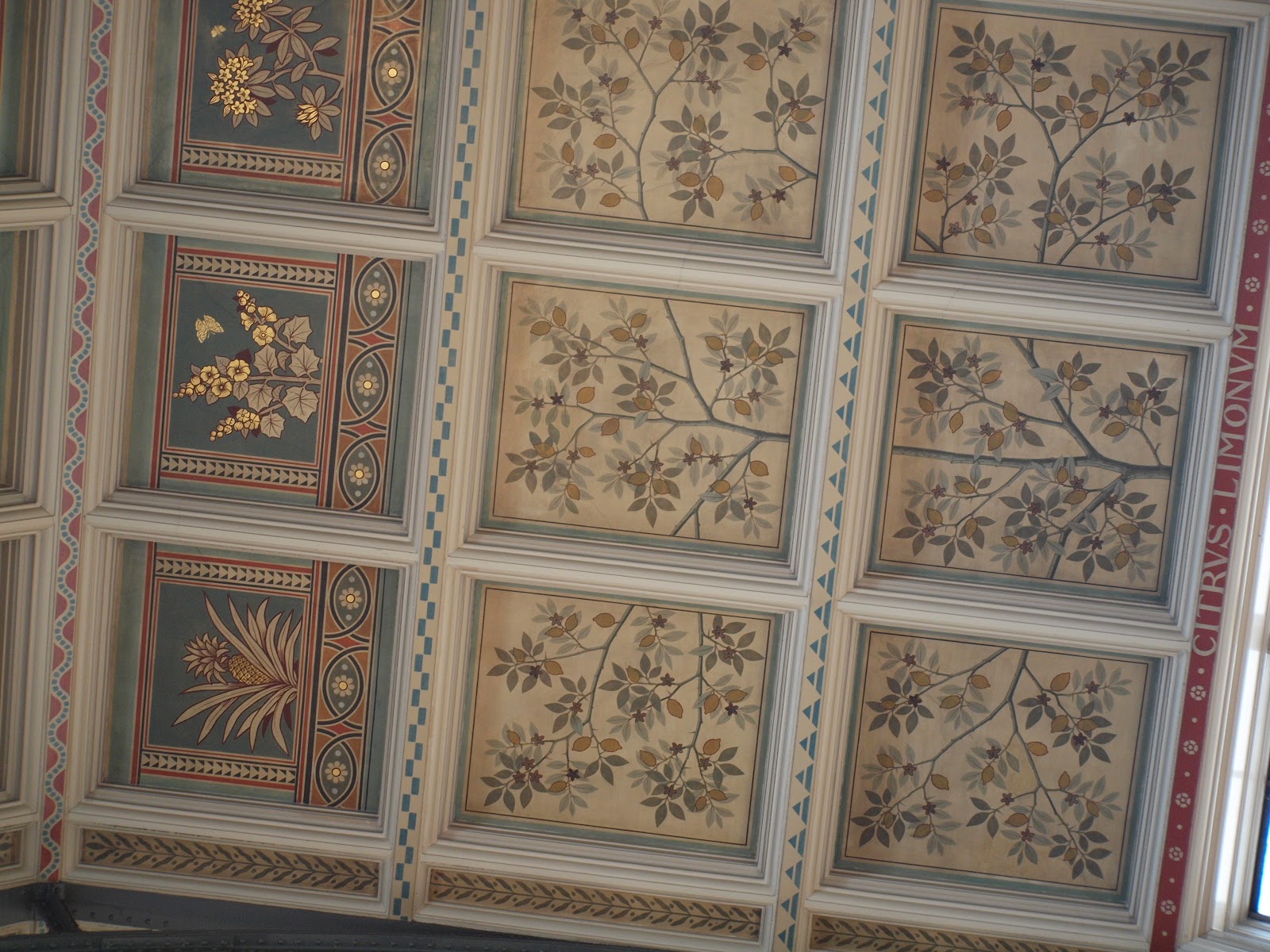
Inside the tribute to the natural world continues with vaulted ceilings and panels - each bearing a different type of plant lovingly represented on the ceiling.  The gilt pears and apples were really too high up to really appreciate - or reach.


The Scott Exhibition
The Natural History Museum currently has an exhibition on the Scott Exhibition to the South Pole - the one where he made it to the Pole - but was not the first, and died on the return journey. Not the most uplifting subject for an exhibition - but certainly fascinating. 

Tony has just finished reading Kim Stanley Robinson's Antarctica aloud to me - which has been such a treat. Its not a small novel and it has taken us the best part of 6 months - picking away at it with sometimes weeks between chapters. KSR wrote the book for the most part as an excuse to write about the history of antarctic expeditions - and one of the main characters in the book leads tour expeditions that recreate the journeys of the explorers - some of them in their amazingly inadequate gear. The concept of doing this is probably more crazy than that of the explorers setting out the first time.

The Cape Evans Hut
So armed with our knowledge of Antarctica courtesy of KSR, we were excited to go and see the exhibit of the famous and fateful trip. The curator had decided to focus much of the exhibition not on the trekking across to the Pole - but on the lives the men lead whilst at the Pole. The artifacts - which included original provisions, gear, diaries, scientific specimens - was set up in a replica of the Cape Evans Hut that the team built on their arrival. In this hut, lined with boxes of provisions, the men slept in bunks side by side for years whilst planning and preparing for the trek to the Pole itself. 

Inside the Cape Evans Hut 
The hut itself still stands in Antarctica - with many of the original provisions and pieces of gear as the team left them. It has been preserved as a national heritage site - and it takes a long time for anything to rot in the Antarctic.

Walking around the exhibition - with lines on the floor marking out where the men's bunks were, where they ate, where Scott wrote his diaries, the most striking thing was the space dedicated in this tiny hut to science. There was a desk for biology another for geology etc. The team collected thousands of specimens that had to be examined on the spot or preserved for the long journey home to England. The also risked their lives on little side expeditions to collect specimens - in one journey called 'the worst journey in the world', the men nearly died in a storm on an expedition to collect penguin eggs. In another case, a group had been sent for the 'summer' to a separate camp to collect specimens and readings and were to return to the Cape Evans Hut for winter. They didn't make it back in time - and so wintered in a snow cave, warmed only by burning seal blubber - I'm assuming they ate the seals too. When they were finally rescued they were coated in black sludge from the burned seal blubber... I can't imagine how they didn't go mad.
The lost team covered in blubber

There was of course a large part of the exhibition dedicated to the trek to the Pole itself. The trek was a bit of a race - with the Norwegian explorer Amundsen setting off at the same time, using dogs to pull sleds, and Scott's team - who were pulling the sleds themselves. Amundsen planned to use the dogs not only to pull them along - but also to eat on the way. Scott's team - pulling their own supplies, had to be careful with weight, gear and food. They had done some preparation trips - setting up food depots along the proposed route to feed them on the way back.

The second team to the Pole. 
Amundsen's team were the first to the Pole - and made it back alive. They didn't have an easy time of it - and in fact Amundsen wrote a letter to Scott that he left at the Pole saying that he wasn't sure they would make it back alive. Scott's team - when they finally made it to the Pole around a month after Amundsen's team - found that they were second. They were crushed - and looks on their faces in the photo at the pole say it all. None of them made it back alive. Scott wrote a number of letters - and kept his diary to the last day. They were found by the team that came searching for them several months later. Many of them were on display in the exhibition - this final letter to the public being one of the most moving - mostly because even in the days before their death - they remained so forthrightly English.


Message to the Public

The causes of the disaster are not due to faulty organisation, but to misfortune in all risks which had to be undertaken.

1. The loss of pony transport in March 1911 obliged me to start later than I had intended, and obliged the limits of stuff transported to be narrowed.

2. The weather throughout the outward journey, and especially the long gale in 83° S., stopped us.

3. The soft snow in lower reaches of glacier again reduced pace.

We fought these untoward events with a will and conquered, but it cut into our provision reserve.

Every detail of our food supplies, clothing and depots made on the interior ice-sheet and over that long stretch of 700 miles to the Pole and back, worked out to perfection. The advance party would have returned to the glacier in fine form and with surplus of food, but for the astonishing failure of the man whom we had least expected to fail. Edgar Evans was thought the strongest man of the party.

The Beardmore Glacier is not difficult in fine weather, but on our return we did not get a single completely fine day; this with a sick companion enormously increased our anxieties.

As I have said elsewhere we got into frightfully rough ice and Edgar Evans received a concussion of the brain--he died a natural death, but left us a shaken party with the season unduly advanced.

But all the facts above enumerated were as nothing to the surprise which awaited us on the Barrier. I maintain that our arrangements for returning were quite adequate, and that no one in the world would have expected the temperatures and surfaces which we encountered at this time of the year. On the summit in lat. 85° 86° we had -20°, -30°. On the Barrier in lat. 82°, 10,000 feet lower, we had -30° in the day, -47° at night pretty regularly, with continuous head wind during our day marches. It is clear that these circumstances come on very suddenly, and our wreck is certainly due to this sudden advent of severe weather, which does not seem to have any satisfactory cause. I do not think human beings ever came through such a month as we have come through, and we should have got through in spite of the weather but for the sickening of a second companion, Captain Oates, and a shortage of fuel in our depots for which I cannot account, and finally, but for the storm which has fallen on us within 11 miles of the depot at which we hoped to secure our final supplies. Surely misfortune could scarcely have exceeded this last blow. We arrived within 11 miles of our old One Ton Camp with fuel for one last meal and food for two days. For four days we have been unable to leave the tent--the gale howling about us. We are weak, writing is difficult, but for my own sake I do not regret this journey, which has shown that Englishmen can endure hardships, help one another, and meet death with as great a fortitude as ever in the past. We took risks, we knew we took them; things have come out against us, and therefore we have no cause for complaint, but bow to the will of Providence, determined still to do our best to the last. But if we have been willing to give our lives to this enterprise, which is for the honour of our country, I appeal to our countrymen to see that those who depend on us are properly cared for.

Had we lived, I should have had a tale to tell of the hardihood, endurance, and courage of my companions which would have stirred the heart of every Englishman. These rough notes and our dead bodies must tell the tale, but surely, surely, a great rich country like ours will see that those who are dependent on us are properly provided for.

R. SCOTT.


All in all we left not exactly uplifted - but filled with a sense of wonder at what these men achieved - and a sense that they must have been more than a little crazy to attempt it in the first place.